Epithelial Layer Fluidization by Curvature-Induced Unjamming
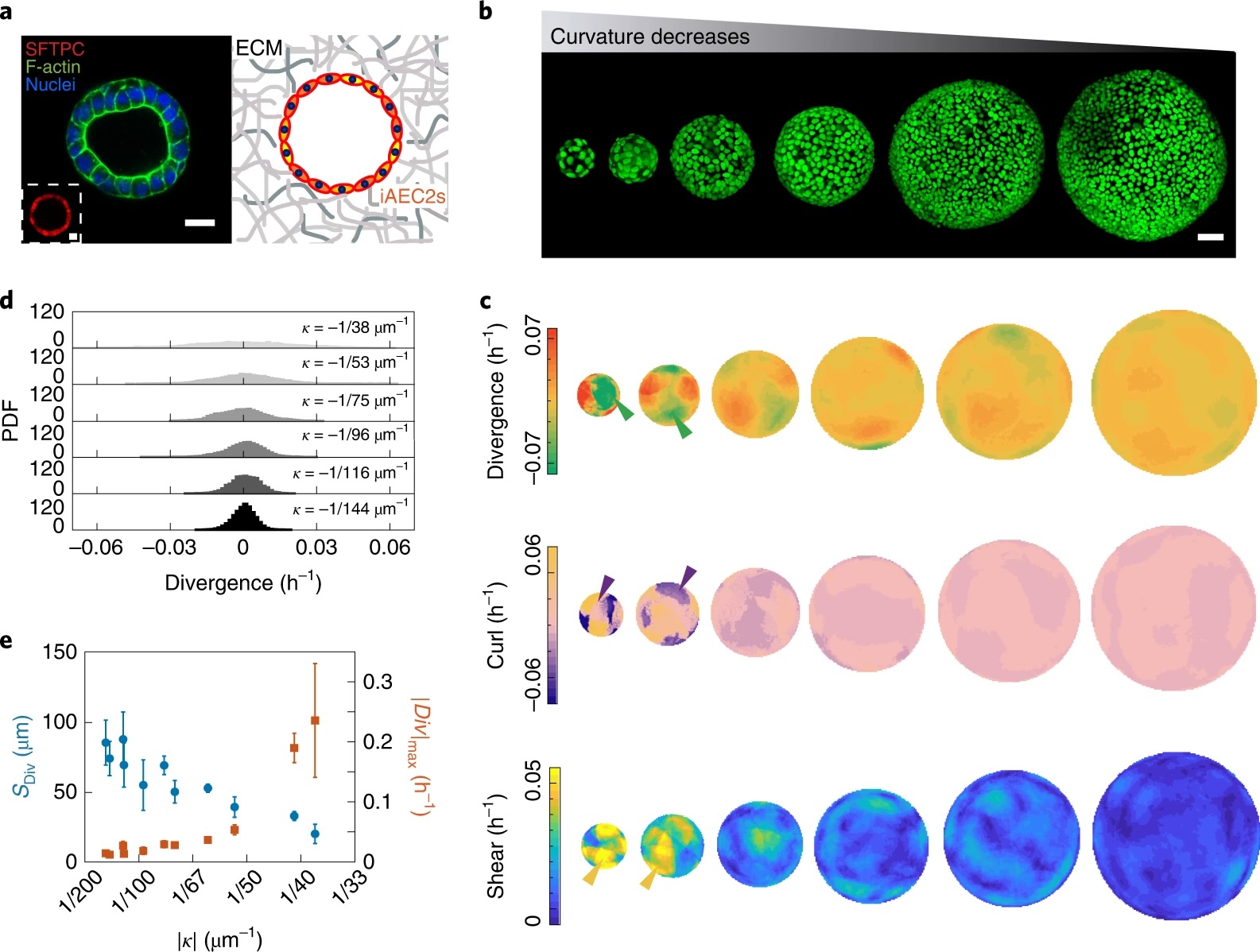
Epithelial tissues in the body are rarely flat — yet most theoretical models of the unjamming transition (UJT) have assumed planar geometry. We lift this restriction by embedding a vertex model on a spherical surface, and find that curvature itself is a powerful driver of tissue fluidization: higher curvature lowers the energy barriers to cellular rearrangement, promoting cell intercalation, mobility, and self-diffusivity. A striking consequence is that small epithelial structures are naturally malleable and migratory, while larger ones become progressively more rigid — a curvature-driven rigidity that emerges purely from geometry. This work introduces an extended phase diagram in which cell shape, motility, and tissue curvature jointly determine whether an epithelial layer flows or stays put, establishing curvature-induced unjamming as a fundamentally new mechanism for epithelial plasticity with direct relevance to wound healing, development, and regeneration.
- De Marzio, M., Das, A., Fredberg, J.J., & Bi, D. “Epithelial layer fluidization by curvature-induced unjamming.” Physical Review Letters 134:138402 (2025). DOI