Order from Chaos: How Cell Division and Motility Sculpt Tissue Structure

In collaboration with Prof. Mark Bowick (KITP/UCSB) and the Velia Fowler Lab (Univ. of Delaware)

Hexagonal packing is a recurring motif in epithelial tissues, and understanding how it arises — and breaks down — requires both theoretical and experimental perspectives. On the theory side, we show that cell division and motility together can drive a liquid→hexatic→liquid transformation in tissues, with hexatic order emerging from a delicate competition between dislocation defects generated by division and disclination-antidisclination binding driven by motility. On the experimental side, work on mouse ocular lens epithelial cells reveals how this kind of ordered packing is actively maintained at the molecular level: nonmuscle myosin IIA (NMIIA) generates anisotropic junctional tension — concentrated along anterior-posterior cell edges — that is essential for stable hexagonal packing during differentiation. A rod domain mutation in NMIIA (E1841K) that disrupts bipolar filament assembly wipes out this tension anisotropy, leading to disordered cell arrangements. Together, these studies paint a coherent picture in which hexatic and hexagonal order in tissues is neither passive nor accidental, but shaped by the interplay of active mechanical forces, topological defects, and cytoskeletal regulation.
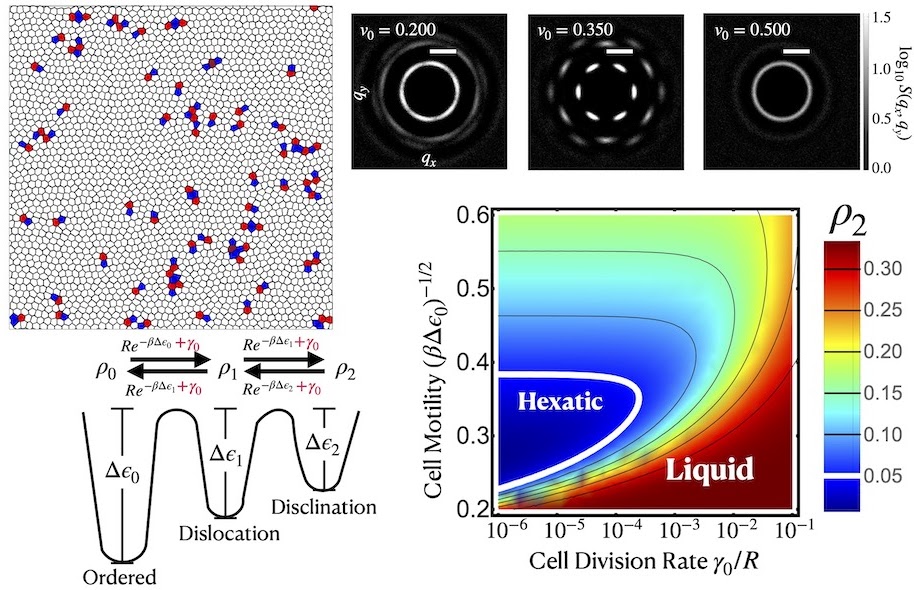
Hexatic order in biological tissues - summary figure showing phase diagram and tissue snapshots
Related Publications:
  • Tang, Y., et al. “Cell Division and Motility Enable Hexatic Order in Biological Tissues.” Physical Review Letters 132.21 (2024): 218402. DOI
  • Islam, S.T., Tang, Y., Boliver, H., Bi, D., & Fowler, V.M. “Non-muscle Myosin IIA (NMIIA) regulates anisotropic cell tension to maintain the hexagonal packing of mouse lens meridional row cells.” Molecular Biology of the Cell (2025). DOI
Yielding, Stiffening, and Avalanches: The Unconventional Mechanics of Epithelial Tissues

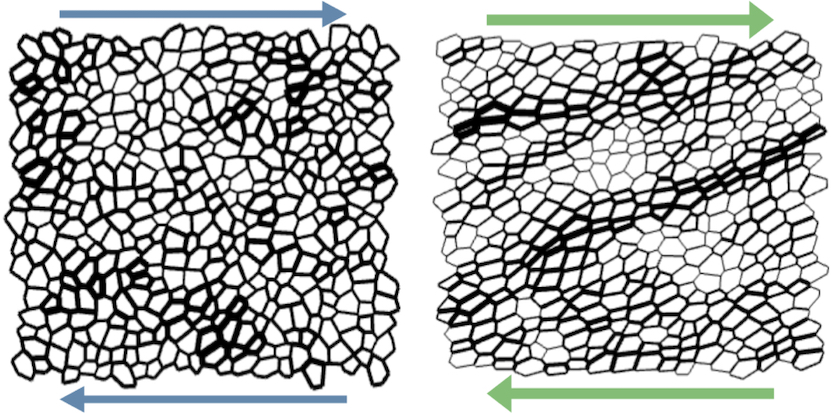
Living tissues are remarkable materials — they can flow, stiffen, yield, and reorganize in ways that defy simple classification. Using cell-based and vertex model simulations, we explore how confluent tissues respond to mechanical deformation across a range of conditions. We show that fluid-like tissues can acquire rigidity under applied shear, with the onset of this shear-driven solidification governed by critical scaling near the liquid-solid transition. In tissues that are already solid-like, large deformations trigger strongly nonlinear responses including substantial stiffening. When cell motility is added to the mix, the interplay between internal active stresses and external deformation produces a rich rheological landscape — yielding, shear thinning, and both continuous and discontinuous shear thickening. At the heart of this complex behavior are irreversible cellular rearrangements that propagate through the tissue like avalanches, governed by stress redistribution and the spatial distribution of mechanically vulnerable cells. We develop mean-field theories and propose experimentally accessible frameworks to interpret these phenomena, offering a unified picture of mechanical plasticity in biological tissues.

Density of states and tissue mechanics
Related Publications:
  • Kayal, S., Nguyen, A.Q., & Bi, D. “The Rheology of Living Tissues: From Cells to Organismal Mechanics.” Annual Review of Condensed Matter Physics 17 (2026). DOI
  • Nguyen, A.Q., Huang, J., & Bi, D. “Origin of yield stress and mechanical plasticity in model biological tissues.” Nature Communications 16:3260 (2025). DOI
  • Divoux, T., et al. “Ductile-to-brittle transition and yielding in soft amorphous materials: perspectives and open questions.” Soft Matter (2024). DOI
  • Xie, X., Sauer, F., Grosser, S., et al. “Effect of non-linear strain stiffening in eDAH and unjamming.” Soft Matter 20(9):1996–2007 (2024). DOI
  • Hertaeg, M.J., Fielding, S.M., & Bi, D. “Discontinuous shear thickening in biological tissue rheology.” Physical Review X 14(1):011027 (2024). DOI
  • Huang, J., Cochran, J., Fielding, S., Marchetti, M., & Bi, D. “Stress-driven rigidity and non-linear elasticity in epithelial tissues.” Physical Review Letters 128:178001 (2022). DOI

Fluid or Solid? The Many Routes to Collective Motion in Epithelial Tissues

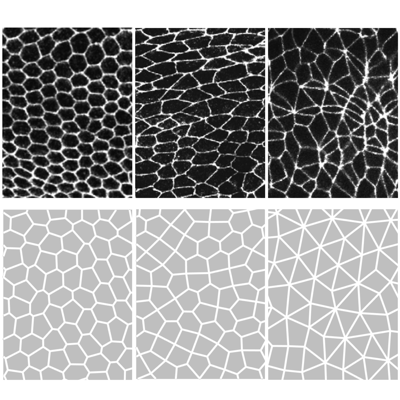
How do epithelial tissues switch between solid-like stillness and fluid-like collective motion? Our work across multiple systems reveals that this jamming-to-unjamming transition (UJT) is a distinct and rich phenomenon, separate from — though interacting with — the epithelial-to-mesenchymal transition (EMT): the two processes fluidize tissue through different mechanisms, with UJT driven primarily by increased cellular propulsion while EMT acts through diminished junctional tension. Beyond this distinction, we find that the UJT landscape is shaped by a surprising range of factors: the time it takes cells to complete neighbor-swapping rearrangements (T1 transitions) produces glassy dynamics, intermittency, and streaming; compressive stress from tumor growth can trigger unjamming through cadherin-mediated adhesion rather than EMT; and in 3D spheroids, matrix confinement controls whether cells sort or collectively invade. To unify confluent and non-confluent tissue geometries within a single framework, we introduce the Active Finite Voronoi model, whose phase diagram bridges collective unjamming and EMT-driven motility. Together, these studies reveal the UJT as a versatile, mechanistically rich gateway to tissue plasticity with broad relevance to development, wound repair, and cancer progression.

Multicellular rosettes and fluid-solid transitions in epithelial tissues
Related Publications:
  • Cai, G., Li, X., Lin, S.-S., et al. “Matrix confinement modulates 3D spheroid sorting and burst-like collective migration.” Acta Biomaterialia 179:192–206 (2024). DOI
  • Huang, J., Levine, H., & Bi, D. “Bridging the gap between collective motility and epithelial–mesenchymal transitions through the active finite voronoi model.” Soft Matter (2023). DOI
  • Cai, G., Nguyen, A., Bashirzadeh, Y., et al. “Compressive stress drives adhesion-dependent unjamming transitions in breast cancer cell migration.” Frontiers in Cell and Developmental Biology 10:933042 (2022). DOI
  • Das, A., Sastry, S., & Bi, D. “Controlled neighbor exchanges drive glassy behavior, intermittency and cell streaming in epithelial tissues.” Physical Review X 11:041037 (2021). DOI
  • Mitchel, J.A., Das, A., O’Sullivan, M., et al. “The unjamming transition is distinct from the epithelial-to-mesenchymal transition.” Nature Communications 11:5053 (2020). DOI
  • Kim, J.-H., et al. “Unjamming and collective migration in MCF10A breast cancer cell lines.” Biochemical and Biophysical Research Communications 521(3) (2020). DOI
  • O’Sullivan, M.J., Mitchel, J.A., Das, A., et al. “Collective migration of non-cancerous, well-differentiated human airway epithelial cells by ionizing radiation.” Frontiers in Cell and Developmental Biology 8 (2020). DOI
  • Yan, L., & Bi, D. “Multicellular rosettes drive fluid-solid transition in epithelial tissues.” Physical Review X 9(1):011029 (2019). DOI

Funding Support

Funding support logos