A Synthetic Biomimetic System for Cell Monolayers

To isolate the role of cell shape in tissue fluidization — free from the confounding effects of density changes and variable motility that plague living systems — we designed a monolayer of synthetic cell mimics and systematically tuned their self-propulsion. We discover a shape-driven, density-independent re-entrant jamming transition, and show that cell shape and shape variability are mutually constrained in the confluent limit, following the same universal scaling seen in real epithelia. These experiments establish cleanly that geometric constraints alone can dictate whether a tissue jams or flows. (Collaboration with Prof. Rajesh Ganapathy, JNCASR)

Related Publication:
  • Arora, P., et al. “A shape-driven reentrant jamming transition in confluent monolayers of synthetic cell-mimics.” Nature Communications 15(1):5645 (2024). DOI
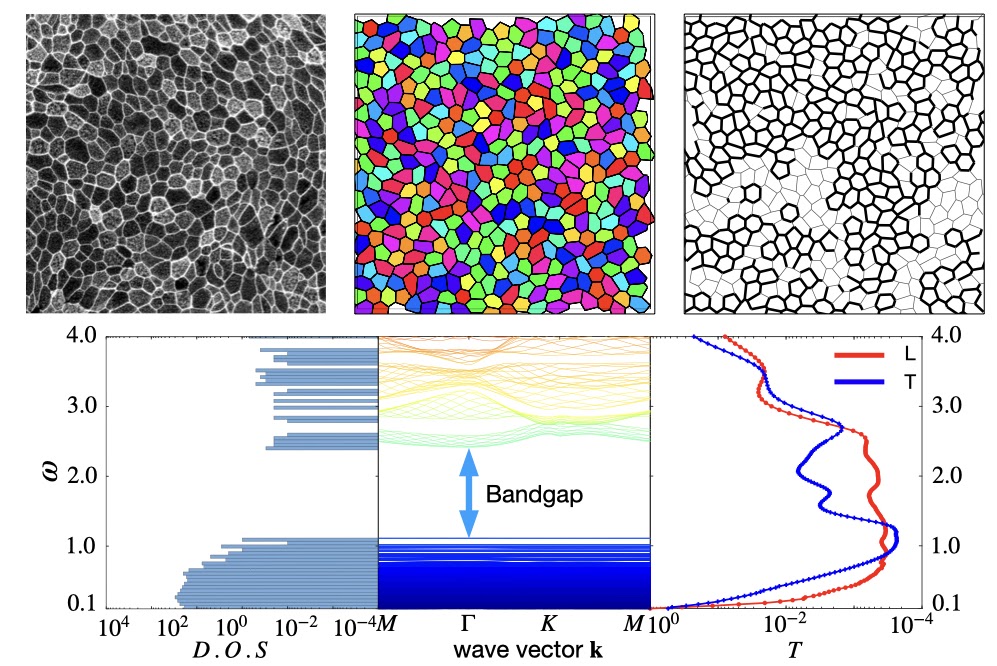
Nature-Inspired Designs for Disordered Acoustic Bandgap Materials

Inspired by how cells pack in biological tissues, we design amorphous mechanical metamaterials with large, tunable acoustic bandgaps. Unlike conventional periodic acoustic crystals, these disordered structures produce directionally isotropic bandgaps that are inherently robust to defects. By tuning tissue-level elastic modulus and local stiffness heterogeneity, we show that the bandgaps can be manipulated on demand — confirmed by transmission coefficient measurements under external sinusoidal driving. This bio-inspired approach opens a path to self-assembled acoustic structures with full, tunable bandgaps for applications from vibration isolation to mechanical waveguiding.

Nature-inspired disordered acoustic bandgap materials
Related Publication:
  • Li, X., & Bi, D. “Nature-inspired designs for disordered acoustic bandgap materials.” Soft Matter 19(42):8221–8227 (2023). DOI

Disordered Photonic Materials

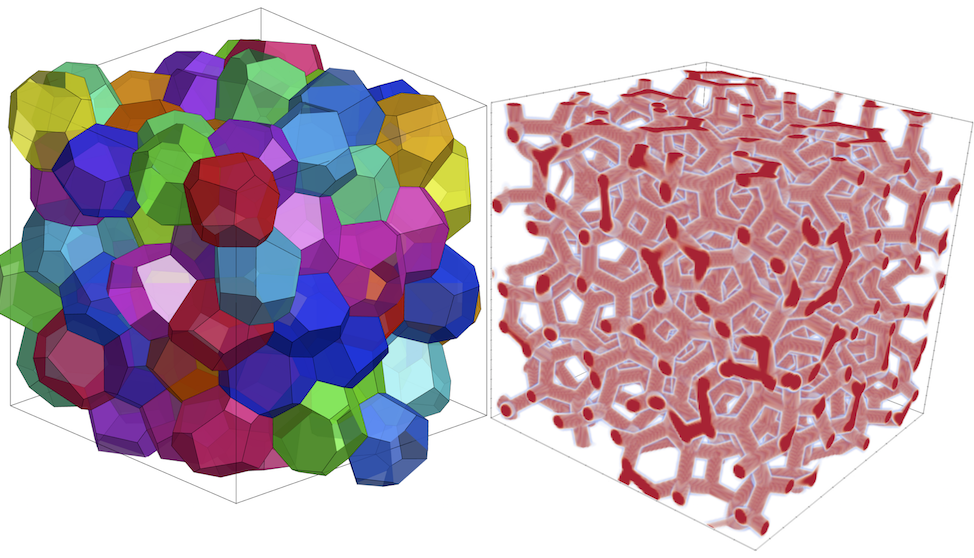
Inspired by how cells pack in biological tissues, we design an amorphous material with a full photonic bandgap tunable in real time through thermal and mechanical perturbations. Crucially, the bandgap survives fluid flow, rearrangements, and thermal fluctuations — persisting in both solid and fluid phases — giving rise to a robust photonic fluid with no counterpart in conventional photonic crystals. This work established the bio-inspired design principles that underpin our broader program in disordered metamaterials, and opens a route to self-assembled, non-rigid photonic structures with dynamically controllable optical properties.

Biological tissue-inspired tunable photonic fluid
Related Publication:
  • Li, X., Das, A., & Bi, D. “Biological tissue-inspired tunable photonic fluid.” Proceedings of the National Academy of Sciences 115(26):6650–6655 (2018). DOI

Funding Support

Funding support logos